













When Machines Learn Prophecy and Power Corrupts Code, Humanity Faces Its Most Dangerous Reckoning

Guy Morris, award-winning thriller author and former tech executive, explores the intersection of artificial intelligence, prophecy, and global power.
A Visionary Voice Bridging Technology Faith And Power
Guy Morris discusses blending AI, prophecy, and geopolitics into gripping thrillers, revealing how real-world research, ethical concerns, and complex narratives shape his thought-provoking, high-stakes storytelling.
G uy Morris arrives at the thriller genre with the rare authority of a life fully lived and rigorously examined. A former Fortune 100 executive, inventor, songwriter and adventurer, he brings to fiction not only a breadth of experience but a disciplined curiosity that elevates his storytelling beyond escapism. His novels do what the very best thrillers achieve: they entertain at pace while quietly insisting that the reader think harder about the world they inhabit.
Across the SNO Chronicles, Morris demonstrates a command of narrative architecture that is both ambitious and controlled. Drawing comparisons with writers such as Dan Brown and Robert Ludlum, his work stands confidently in that lineage while carving out its own intellectual territory. Where others rely on spectacle alone, Morris grounds his plots in painstaking research—melding artificial intelligence, geopolitics and theological inquiry into stories that feel unsettlingly plausible. The result is fiction that lingers, provoking questions long after the final page is turned.
What distinguishes Morris most is his refusal to simplify complexity. His novels embrace the tangled realities of modern power structures, technological acceleration and moral ambiguity, yet remain accessible through sharply drawn characters and propulsive pacing. There is a moral seriousness underpinning his work, a belief that storytelling can illuminate as well as entertain. That balance—between urgency and reflection, tension and substance—is no small achievement.
This interview with us offers a compelling glimpse into the mind behind those narratives: a writer who approaches fiction with the precision of an engineer, the imagination of a futurist, and the conscience of a social commentator. As readers of Novelist Post will discover, Guy Morris is not merely writing thrillers—he is mapping the fault lines of our present and imagining where they may lead next.
What inspired the concept behind SWARM: When Artificial Intelligence Decodes End Time Prophecies, particularly the fusion of artificial intelligence and biblical prophecy?
Great question. First, I should point out that SWARM is the first book in the multiple award-winning SNO Chronicles series, which also includes The Last Ark and The Image. Key themes, characters carry through the series for a more complex narrative and character arcs.
Key inspiration for SWARM and the series came from two separate real-world experiences that shaped my own personal worldview and launched decades of research.
The first key inspirational discovery happened in the late 1990s when I stumbled onto an Associated Press article that said simply that “a program had escaped the Lawrence Livermore Laboratories at Sandia.” Instantly obsessed with unraveling how a program could escape a government spy lab, and why would the NSA want to design it that way, I spent a year developing a plausible solution. After creating an award-winning webisode series featuring the program as an escaped AI, two FBI agents showed up at my door. They were upset, I was snarky, it was the best night ever!
The roots of decoding prophecy came from a personal obsession. Inspired by the work of Sir Issac Newton, I spent four decades developing the Prophecy Analytics framework to decode prophecy. I didn’t want opinion, theology, or rehashed eschatology. I wanted a fresh, bias free, culture-free, verifiable model that would ignore layers of allegory, metaphor, and dogma to focus on outcomes, facts, correlations, and probabilities. Similar to a modern AI might approach the problem, and how I designed complex systems in the past.
Prophecy Analytics has revealed hundreds of perfect correlations between our modern reality and the ancient text with an astonishing cumulative probability exceeding three trillion to one. Actual math.
Combining the analysis and conclusions of Prophecy Analytics with the true-story based AI character of SLVIA creates a unique and powerful AI narrative that connects the threat of AI to our shared humanity. That combination also expands the narrative into political intrigue, science, and technological realism, within a nuanced spiritual, religious, and philosophical context. The result is profoundly thought-provoking because it parallels our reality.
SWARM and the SNO Chronicles series are not a dystopian fantasy of the distant future, but tomorrow morning’s potential breaking headline news in the form of a page-turning thriller with warm, flawed but ethical characters fighting for our shared humanity. Not against the AI systems, but against the corruption of power, and the techno oligarchy style of feudalism, and lethal autonomous weapon systems, mass surveillance, and sociopathic billionaires leading us.
How did you research and develop the technological aspects of AI to make the narrative feel so realistic?
My expertise is rooted in four-decades in Fortune 500 global energy, high-tech, and software with Oxy, IBM, Oracle, and Microsoft. A recognized thought-leader and innovator, often at the spear-head of leading technology into the enterprise, including early-stages of what we now call artificial intelligence.
Expected in June 2026, Sunbury Press will publish my nonfiction called The AI Tsunami: A Survival Guide for Humanity. Targeted at consumers, students, white-collar workers, and small businesses, the AI Tsunami will provide a comprehensive, but easy-to-understand guide on the history, types, benefits, risks, guardrails, and strategies for individuals and small businesses to survive and thrive.
Your work is often compared to Dan Brown and Robert Ludlum—how have these authors influenced your writing style?
I am always humbled and honored to receive such comparisons. The books of Dan Brown, Michael Crichton, James Rollins, Steve Berry, and others inspire me deeply and fill my personal library.
Each one of them researches deeply before they write, pulling their premises, scenes, locations, and conflicts from a factual foundation. Discovering and fictionalizing the connections between past and present, science and religion, war and power, presented with enough authenticity and plausibility to inspire me to learn more and aspire to be compared with those I respect.
What drew you to explore religious artefacts and historical mysteries in The Last Ark: Lost Secrets of Qumran?
To explore the journey of SLVIA to validate the modern correlation to prophecy, which includes the prophecy of a third Jewish temple. Were there enough facts to build a believable plot not saturated in religious dogma and biases?
A temple requires a location, a red heifer sacrifice, and a sacred ark to sprinkle the blood of the sacrifice. From a religious perspective, neither a temple nor a sacrifice makes sense without an ark.
What started as research into traditional views and known facts led to the discovery that two arks, not one, were made, documented in scriptural texts, and both were in play in the past decade, never covered by the media. The information was so astonishing that it not only became a central theme of the book, but changed the conclusions within the Prophecy Analytics framework. A speculative scenario emerged based on those facts and the Middle East of early 2023, before the war, which occurred not long after The Last Ark published.
While my narrative is fictional, the factual modern events of the two historic Arks, combined with the powder-keg dynamics in Israel, could have played an unseen role in the historic tragedy that took place in Israel and then Gaza in October 2023, and the historic human travesty of ethnic cleansing in Gaza.
How do you balance complex themes like geopolitics, religion, and advanced technology without overwhelming the reader?
One practical method is to bounce early versions of key chapters off close friends who are easily confused by complex themes. I listened carefully to their response.
In the end, I hope to lift my readers’ awareness of how our complex world connects through an exciting narrative, with fun, humorous, and warm characters. To accomplish that connection, I design characters to carry the burden of the various themes (pro and con). How the characters interact with each other must not only advance the plot but weave the themes into the narrative through a POV, motive, actions, and dialogue.
If I can weave layers and threads to create a rich, intriguing, and textured narrative, it can be a rich environment for surprises and connections without being cliche. I love that nuanced complexity, and trust that my readers do as well, if I execute well.
Another critical lesson-learned is to be savage in removing details that are not absolutely critical or necessary in moving the story forward. No mercy. If not connecting to something critical later in the story, those details clutter. Instead, I strive to offer just enough information to move the narrative forward and connect to the larger themes.
The SNO Chronicles feature interconnected storylines—how do you plan and structure such intricate plots?
Carefully, and with a ton of mistakes and revisions. Seriously, often over thirty. An obsessive plotter, each book is unique, but fits within a broad-brush plan for the entire series involving the characters and key themes. The SNO Chronicles has an intentional message wrapped in pulse-pounding and intriguing entertainment.
I take a highly structured approach, unnecessary on most fictional narratives because I am intentionally making connections to the real world to encourage the reader to ask questions about the direction of society once we connect the evidence hidden in plain sight.
More than thrillers, my books carry a social commentary on the dangerous and historical convergence of the rapid rise of AI power in the hands of corruption in geopolitical power and the mathematical alignment to ancient prophetic texts. A warning to humanity. A point of no return.
To achieve this, I have learned to start with three major themes to cover: AI, geopolitics, and prophecy. Themes are found in current events, leading edge science and AI tech, or one of the startling conclusions of Prophecy Analytics.
Step two is a conceptual and observational step of how the themes connect. The most challenging step that requires playing out scenarios until one connects themes within a plausible scenario.
From these themes, I also map out character driven themes, so that each theme has a pro/con voice that impacts a character’s arc. Connecting themes to characters also helps define how characters and stories interconnect later on.
Plot points are often driven by external events, driven by a theme. Something happens that forces our characters to respond. Character responses pull the story forward, and their voice defines how their unique arc might change as a result.
Chapter by chapter outlines include POV, what happens to what characters with what themes, or technology, prophecy, and geopolitical research facts to be revealed.
Never perfect, it forms a foundation for an easy to finish first draft, while allowing for creative or inspirational deviations while writing.
Since I agree with Stephen King that first drafts suck, the hard part of adding, cutting, moving, rewriting, and revision cycles until perfected begins.
What role does real-world inspiration play in shaping your thrillers, and how do you decide what to fictionalise?
Absolutely everything. The trick is to choose which issue from a deluge of issues to select a set of issues that map to themes, research, write and publish ahead of actual events catching up to the fictional narrative that began months earlier. Reality is moving way faster than I can write as speculative and publish.
The real world and the world of the SNO Chronicles series are not perfectly aligned, but there are many researched facts, details, and parallels that intentionally align and overlap.
Walking the thin line between real and fiction increases the intensity of the reader’s experience and drives residual thought-provoking questions weeks or even months later. The format permits social commentary and debate on issues relevant to the reader’s reality during an unprecedented time in history, while avoiding the legal liability of names.
While enabling factual information on artificial intelligence and other tech, science, religion, history, institutions, and more.
Your novels often question the ethics of artificial intelligence—what are your own views on the future of AI?
In a single word. Mixed. Three words. Excited and terrified.
I spent a career at the leading edge of technology adoption, innovation into Fortune 1000 and U.S. government operations. I’m an advocate of building tech to help humans perform better with more control of the data to make better decisions.
There are powerful, history changing benefits to machine intelligence. But only if we apply those innovations to improving the human condition and prospects for the future through a filter of legislation, penalties, criminal and other guardrails to protect humanity, and abuse of power. The technology is moving faster than our legislation, government, law enforcement, and protection against official, corporate, criminal, military, or foreign abuse and malicious use.
Without those guardrails, as the power of AI grows uncheck, and the corruption of power continues unchecked, the potential for an existential threat to civilization as it exists becomes significant and measurable.
In the SNO Chronicles, SLVIA is depicted as neither evil nor benign to highlight that the actual danger of AI is not the machine itself, at least not in the short term. Rather, the greater threat to humanity is how a sociopathic billionaire, a corrupt CEO or politician, a drug lord, warlord, dictator, or malicious criminal might do with so much power. Which all pales compared to the ambitions of the CIA, NSA, DOD, DOJ, Congress, White House, or their contractors such as X AI and Palantir, might do with our information and the power of intelligent surveillance and machines. The U.S. Congress is missing the chance to exercise that choice.
Gee, what could go wrong?
SWARM focused on the threat of lethal autonomous weapons in 2020, while the spat between Anthropic and the U.S. DOD drew media attention in 2026. The public knows so little.
Humanity stands at a crossroads with how to develop and deploy this technology, which could lead to either a utopian or dystopian future. In my upcoming book, The AI Tsunami: A Survival Guide for Humanity, we discuss the good, the bad, and the existential ugly of AI, along with the personal and legislative choices we needed to make eight years ago when I started writing SWARM, but could be existential if we do not get to the table soon.
What writing tips would you offer to aspiring authors who want to write intelligent, research-driven thrillers?
Become a Renaissance author, dabbling in all fields of knowledge, including history, religion, politics, faith, and science. Learn to love learning everything. Put your head into learning enough to ask questions, be plausible in what can go wrong and how to fix it, and make it relevant to the reader. Readers can tell when we are making it up from thin air, and they close the book when they do. Don’t let them.
Of course, in a thriller, there are times we want the protagonist to make it better. Research to make sure it can be done, but make sure it is really hard.
Keep the premise and key scenes plausible (research), but on the edge of the probable (research).
And for reader’s sake, avoid the temptation to overload too much detail, which will bore the reader, drag the pacing, and pull their attention away from the story. Keep it lean and moving forward.
What advice would you give to aspiring authors trying to break into the thriller genre?
Unless you are exceptionally talented, well-connected, or lucky, plan on a separate income to maintain the sustainability needed to build a read list and loyal readers. In other words, don’t plan to be the next Dan Brown on your first book. But don’t let that stop you from writing an award-winning book, or two, or four, or more.
Thrillers are a uniquely challenging genre. Devour as many as possible to learn as much as possible. The characters need to be flawed yet moral, but not pathetic. The plot needs to be plausible, but not expected or cliche. Suspense and pacing need to create a roller-coaster thrill ride. Violence needs to be sparing and strategic.
A staging of the mysteries or clues or shocking reveals must slowly build to the right point, without giving away too much, and must always be unexpected. Thrillers almost always have multiple POV character narratives, which means really getting into the head, history, motives, fears, habits, ticks, mannerisms, lifestyle, and maybe even food preferences of each.
You can write so many genres without planning. Not a thriller. Plots, locations, themes, and characters with layers of mystery and obstacles all take research and careful planning.
How do you maintain suspense and pacing throughout a long, action-driven novel?
Three steps to maintaining pace and suspense work for me, but I’m still striving to perfect the magic.
It starts with a five-page or less chapter limit, to capture quick scenes that move the story, with exceptions as needed. Don’t bog down into a really long chapter or scene. Even if the same scene, change the POV and chapter, then keep it moving.
Suspense requires a mystery, an unknown. Actually, an entire set of unknowns, some embedded and others cascading consequences of choices. Keep the pages turning.
Set up later reveals with hints or teases of the unknown along the way. If you fulfill one promise, you need to make another. One mystery solved, must open a new one.
I find it useful to start chapters in the middle of the action and fill in the background as I progress through the chapter. The technique inherently gives the chapter a greater sense of urgency, even if nothing dramatic happens.
Third, and most importantly, make it an arduous journey for the protagonist. If something can go wrong, make it go really, really wrong. The protagonist’s goal must seem impossible at times.
Finally, and the bonus point. Use a countdown. A deadline that drives urgency, a constant reminder that time is running out, should tick in the back of the reader’s head.
What is the most valuable lesson you have learned as an author that could benefit other writers?
Writing your heart-pounding, mind-twisting masterpiece is the simple part. The hard work has only just begun. Finding and building an audience takes the sustainability of building a read list of outstanding books, and not planning for that sustainability is where the dreams of many talented authors fail.
Promotion and marketing can cost hundreds, thousands to tens of thousands, and often doesn’t generate adequate sales to provide enough royalties to help the author cover the costs.
Avoid high-cost promotions guaranteed to earn you ‘best-seller’ status on Amazon. In reality, if they don’t succeed, good with the refund, and if they do, that status may last only for a day or less. Bottom line, the promotion will cost more than it earns. Fine to kick start attention, but not a sustainable model.
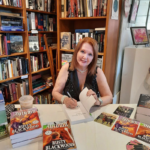
I found success by building a network of direct sale book signing events with a recurring sixty or more book signing days per year. I now sell better than many Penguin-Random House authors with an older read list, but none of it shows up because I buy at print cost and sell direct, which cuts out Amazon or distribution cuts.
Don’t just plan to write a book, or even get a publishing deal, you are launching a book business in which the author funds and manages most promotion and marketing. Only a few percent of new authors are overnight best-sellers. Plan for other income sources to build a read-list for a sustainable presence with the readers.