











John McKay Illuminates the Forgotten Frontlines of World War Two Through Powerful Historical Storytelling
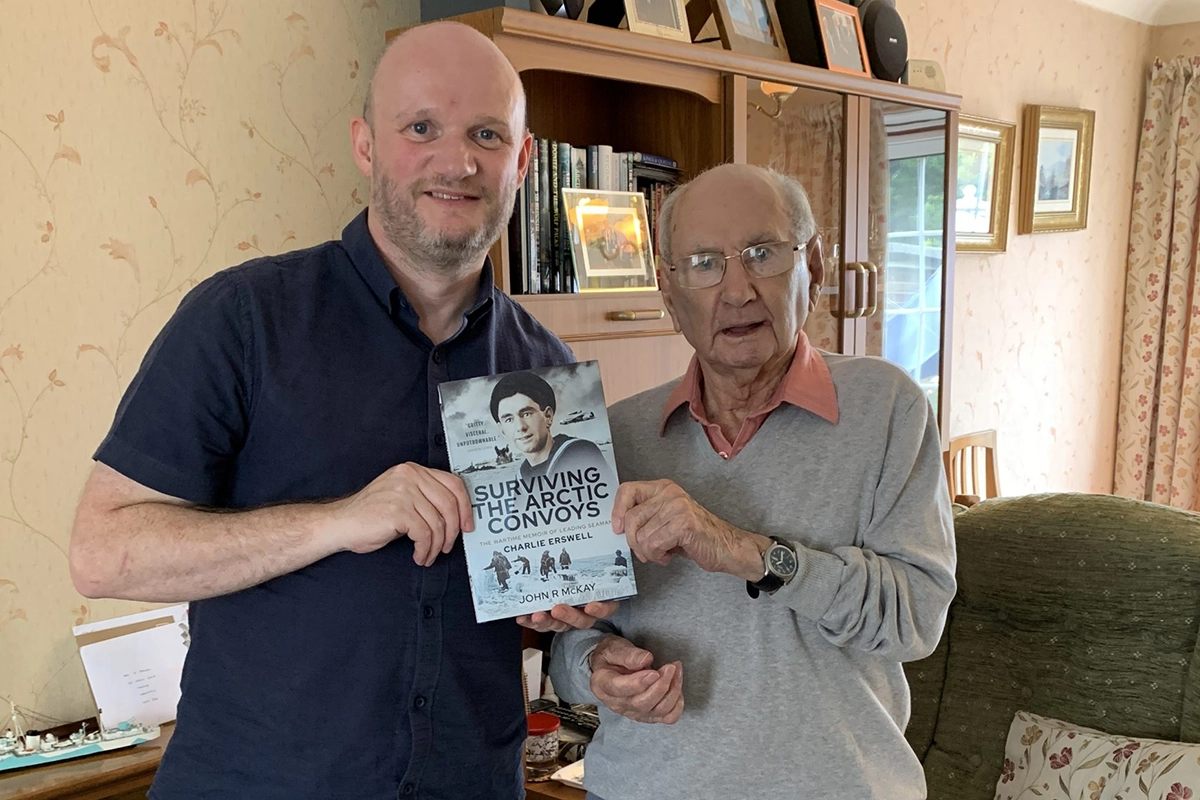
Author John McKay with Arctic Convoy veteran Charlie Erswell, whose wartime memoir McKay helped bring to life, preserving an extraordinary first-hand account of the Second World War.
From RAF Service To Award-Winning Novels, A Writer Dedicated To Preserving The Human Truth Of History
John McKay discusses his military background, passion for WWII history, and writing journey, highlighting his focus on Arctic convoys, character-driven storytelling, historical responsibility, and transforming real events into compelling fiction.
J ohn McKay brings to historical fiction a rare blend of lived discipline, operational experience, and deep archival curiosity. A former Royal Air Force serviceman and later a member of the Fire and Rescue Service, McKay’s writing is grounded in a lifetime of service, teamwork, and close engagement with high-pressure environments. That background is evident throughout his work, where authenticity of voice and attention to procedural detail sit alongside a strong sense of human resilience under strain.
Best known for his powerful explorations of the Second World War—particularly the often-overlooked Arctic convoys—McKay has carved out a distinctive space in contemporary military fiction and narrative non-fiction. From his award-winning novel Hell and High Water to his acclaimed Manner of Men series, which pays tribute to Britain’s airborne forces, his books combine meticulous research with vivid storytelling. His work on Arctic Convoy PQ18 and the memoir of veteran Charlie Erswell further demonstrates his commitment to preserving lived memory, ensuring that individual voices from history are neither softened nor lost.
What sets McKay apart is not only the scale of his historical ambition, but the intimacy he brings to it. Whether contributing to museum exhibitions, helping shape memorial projects, or translating short fiction into fully realised novels, he consistently bridges the gap between historical record and human experience. In this interview, he reflects on the craft, responsibility, and persistence behind that work—offering insight into a writing career built on service, storytelling, and a profound respect for the past.
How did your seven years of service in the Royal Air Force and your subsequent career in the Fire and Rescue Service influence your approach to writing about military history?
I have always had a fascination with the two World Wars. During my time in the RAF, I was stationed in Belgium and was fortunate enough to visit several historic battle sites, which further deepened that interest. My experience in both the armed forces and the emergency services has given me a strong understanding of the camaraderie that exists between people in uniform.
As most of my work is fiction, I am able to draw on these experiences, combining them with imagination to create three-dimensional, believable characters. Placing these characters within real historical events has proven both enjoyable and immensely rewarding.
What first sparked your childhood ambition to become a writer, and why was now the right time to finally pursue it?
I have always been an avid reader across a range of genres, though history has consistently been my main interest. Growing up, I was fascinated by how authors constructed their stories and often wondered whether I would one day have the skill and patience to do the same.
It wasn’t until my forties that I decided to pursue writing seriously. After reading a few average books in succession, I found myself thinking I might be able to do better. By that stage in life, I had also developed the patience required to commit to the process. My careers in the RAF and Fire and Rescue Service instilled in me a methodical approach and a strong attention to detail, which proved invaluable. It felt like a ‘now or never’ moment—and since then, I’ve completed over a dozen books.
Given your extensive research into the Arctic convoys, what is the most surprising fact you uncovered that didn’t make it into the final versions of your books?
The Arctic convoys represented a vast and perilous undertaking, delivering arms and materiel to the Soviet Union during the war. There were seventy-six convoys travelling to and from Murmansk and Archangelsk, with the final one taking place as late as May 1945.
The conditions faced by those involved were extreme—well below freezing temperatures, constant threats from submarines and surface vessels, and relentless aerial attacks from the Luftwaffe. It was a brutal and unforgiving theatre of war that, in my view, has not received the recognition it deserves.
Perhaps the most surprising aspect is that, even now—over eighty years later—there is still so much to learn. Many stories from those voyages remain untold, and there is still a great deal of history waiting to be uncovered.
How did you manage the emotional responsibility of completing Charlie Erswell’s wartime memoir and ensuring his voice remained authentic?
I felt a profound sense of responsibility and was deeply humbled that Charlie trusted me to tell his story. Although we only knew each other for a relatively short time, we became firm friends, and it felt natural for me to take on the task.
Charlie was in his early nineties when we worked together on Surviving the Arctic Convoys, yet his memory remained remarkably sharp. His humility and sense of humour—traits common among many WWII veterans I’ve met—had a strong influence on the tone of the narrative. I wanted to portray him as he truly was: an ordinary man placed in extraordinary circumstances.
While his recollections formed the heart of the book, I also undertook extensive research, particularly surrounding Convoy PQ18, to ensure historical accuracy. Writing in the first person from Charlie’s perspective helped maintain authenticity and kept the story grounded in his personal experience.
What were the specific challenges of writing about PQ18 from the perspective of both the Allied defenders and the German attackers?
Many historical works can feel somewhat sterile, often focusing heavily on strategy and factual detail at the expense of the human experience. My aim has always been to create immersive narratives that convey what it actually felt like to be there—whether as a bomber pilot approaching a target or as a sailor defending against U-boats and aerial attacks.
In writing about PQ18, I wanted to capture both the strategic and personal elements of the conflict, highlighting not only the decisions of commanders but also the experiences of those on the front line.
One of the main challenges was the relative scarcity of source material from the German perspective. Despite this, I believe the book achieves a balanced portrayal, combining factual accuracy with compelling first-hand accounts from individuals across all ranks.
How did it feel to see your short story, V for Victory, reach the USA Today bestseller list and transition into a full-length novel?
V for Victory began as a short story for a World War Two resistance anthology. At the time, I was researching my novel Codename Greyman and developed the idea from that work.
When the anthology reached the USA Today bestseller list, it was a tremendous boost to my confidence and something I was very proud of—it was validation that my work was resonating with readers. The anthology was released on a limited basis, with proceeds donated to the United States Holocaust Memorial Museum in Washington, DC.
Expanding the story into a full-length novel felt surprisingly natural. The longer format allowed me to develop characters and events in greater depth, building on ideas that had been constrained by the short story format. The novel now forms part of my WWII France trilogy, alongside The Absolution of Otto Finkel and Codename Greyman.
Could you describe the process of collaborating with the Western Approaches Museum to create a permanent exhibition for the Arctic convoys?
Following my work on the Arctic convoys and Charlie’s memoir, I was approached by the Western Approaches Museum for my input. The museum itself served as the headquarters for coordinating the Atlantic convoys during the war and also oversaw the early stages of the Arctic convoys.
Living nearby allowed me to work closely with the team, providing background information, research materials, and guidance on exhibit content. I was also invited to sit on the judging panel for a literary prize associated with the exhibition’s launch.
Overall, it was a highly rewarding and uplifting experience to contribute to a project of such historical importance.
How has living in Wigan influenced your involvement in local projects, such as the memorial for the SAS hero Tom ‘Ginger’ Jones?
After reading Damien Lewis’s SAS Band of Brothers, I was struck by the story of Tom ‘Ginger’ Jones, an original member of the SAS who, like me, was from Wigan. I was surprised that I had never heard of him before.
Motivated by this, I contacted the local council and Ginger’s family, including his son Norman. Together, we successfully secured funding for a permanent memorial at the Wigan Armed Forces Centre.
Damien Lewis kindly attended the unveiling to give a talk, and the event was attended by Ginger’s family and local dignitaries. It was a proud moment for the community and a fitting tribute to a remarkable individual.
What draws you specifically to the airborne forces of the Second World War for your Manner of Men series?
As a child, I watched films such as The Longest Day and A Bridge Too Far, which sparked my fascination with airborne forces and the bravery required to parachute into combat—something I personally would never contemplate.
This interest was further fuelled by reading extensively on the subject, including works by Damien Lewis. When my publisher approached me about writing a WWII trilogy, focusing on British paratroopers felt like a natural choice.
With my background in the armed forces and my existing knowledge of the subject, I felt well-equipped to do it justice. I have since completed the fifth book in the series, which I hope to release in the summer.
In your opinion, why has the significance of the Arctic convoys been so frequently underestimated in broader histories of the Second World War?
This is an issue that deeply affected many Arctic convoy veterans. Charlie Erswell often spoke about how those who served on these missions felt overlooked after the war.
One possible reason is the onset of the Cold War, which saw the Soviet Union shift from ally to adversary. This may have contributed to the convoys receiving less recognition.
I wouldn’t necessarily say they have been underestimated by historians, but there has certainly been a lack of public awareness. Unlike campaigns such as D-Day or North Africa, the Arctic convoys have rarely been depicted in film and have only recently begun to receive wider attention in literature. I hope the books I have written on the subject goes some way to giving these men the recognition they fully deserve.
What practical writing tips would you offer to aspiring authors who are looking to turn a short story into a full-length historical novel?
In my experience, this process can be quite straightforward. The most important thing to remember is that the core story already exists—you’ve done the hardest part.
From there, focus on expanding the narrative by introducing subplots and developing characters in greater depth. As you do so, new ideas will naturally emerge, and the word count will grow. Before long, you’ll find yourself with a fully realised novel.
What is your primary piece of advice for aspiring authors who are trying to balance a demanding full-time career with their passion for writing?
Persistence and patience are key. Writing alongside a full-time career can be challenging, and progress may feel slow at times. However, steady effort will yield results.
Even writing 500 to 1,000 words per session will eventually lead to a completed first draft. Once that milestone is reached, the editing process begins—and that’s where the real refinement takes place.
Praise for the author and book.
Operation Codicil (Manner of Men Book 1) – ‘McKay delivers wall to wall action and characters to die for. As the elite pathfinders encounter their own Bridge Too Far.’
– Damien Lewis
Target Arnhem (Manner of Men Book 2) – ‘A cracking story, which also gives the reader a window into Arnhem and the Airborne forces.’
– Saul David
In For the Kill (Manner of Men Book 3) – “A thrilling tale about soldiers and the mission. Recommended for fans of James Holland and Damien Lewis.”
–Thomas Waugh
The Lost Patrol (Manner of Men Book 4) – “From the first rumble of the panzer engines, you know you’re embarking on a classic, full‑blooded adventure.”
– Alan Bardos
Codename Greyman – “A gripping thriller that brings the clandestine world of the shadow war to life with heart-pounding authenticity.”
– Damien Lewis
Surviving the Arctic Convoys – The Wartime Memoir of Leading Seaman Charlie Erswell – ‘Gritty. Visceral. Unputdownable. The story of the heroes of the Arctic Convoys is so little known, and this timely and highly authentic book does it full justice. McKay’s work is a fabulous addition to any WWII library.’
– Damien Lewis
Arctic Convoy PQ18 – 25 Days that Changed the Course of the War – ‘Riveting and compelling. McKay brings to life the remarkable true story of one of the most important Allied seaborne operations of the Second World War. A must read.’
– Damien Lewis