











Eric Landfried Weaves Faith and Resilience Into Gripping Post-Apocalyptic Novels

Photo: Eric Landfried: An extraordinary storyteller merging faith, grit, and redemption to craft unforgettable journeys through post-apocalyptic worlds.
A Storyteller of Deep Hope and Unflinching Grit
Eric Landfried blends faith-filled hope and gritty realism in his post-apocalyptic stories, inspired by his personal experiences, faith, and love for storytelling rooted in imaginative and redemptive themes.
E ric Landfried’s literary journey is as compelling as the stories he pens. From the tender age of thirteen, armed with a spiral notebook and boundless imagination, Eric discovered the transformative power of writing. What began as a way for a shy boy in West Virginia to express himself has blossomed into a remarkable career characterized by narratives that seamlessly intertwine profound faith and hauntingly vivid post-apocalyptic landscapes. His ability to weave together unyielding realism and redemptive hope is a testimony of his talent and his personal experiences—the victories, the struggles, and the enduring belief in something greater.
In this issue, we delve into the creative world of Eric Landfried, whose acclaimed novel Solitary Man has captivated readers with its gripping tale of survival, morality, and faith set against a backdrop of despair and chaos. With each character, Eric brings his audience face-to-face with the tension between light and darkness, hope and cynicism. It is a reflection of his own internal push and pull, and his stories resonate with emotional honesty and spiritual resilience. Through his vivid prose, he not only offers a thrilling escape but also a challenge—to reflect on the endurance of our own faith in the face of life’s fiercest trials.
Eric Landfried’s masterful writing delivers thought-provoking, faith-centered novels that captivate readers through their emotional depth and unflinching realism.
In our conversation, Eric opens the door to his creative process, shares his inspirations—from his childhood love of Mad Max to the redemptive arcs he witnessed in his personal life—and provides insight into the challenges and triumphs of weaving faith into gritty, dystopian narratives. Whether you are already a fan of his work or discovering his stories for the first time, Eric’s journey will inspire both readers and aspiring writers alike. This interview is more than just a glimpse into his world; it’s an exploration of the power of storytelling, the resilience of faith, and the hope that shines even in the darkest corners. Prepare to be moved, challenged, and inspired.
What inspired you to write “Solitary Man” and how did you develop its unique mix of faith and post-apocalyptic themes?
Two things contributing to my identity are my faith in Jesus and being a former 80’s kid, loving much of the pop culture from then. One of my favorites is the Mad Max series, and while considering those movies, I wondered what it would be like for a Christian like me to function in a postapocalyptic world. Once I had the seed idea, I started developing the story from there.
“My two leads are the two sides of me—Jonathan is hopeful, diligent, and faithful, while Doyle is introverted, gruff, and cynical.” – Eric Landfried
How has your personal journey as a writer shaped the characters and storylines in your books?
I think most writers tend to insert bits of themselves into their characters. I’m no different. My two leads are the two sides of me. Jonathan is hopeful, diligent, and faithful. In contrast, Doyle is introverted, gruff, and cynical. I’m somehow a contradictory mix of all these things.
When developing storylines, my cynical side battles with my hopeful side. I’m not a fan of neat and tidy stories, but I also don’t want to leave a reader in the throes of despair. I prefer endings that are hopeful, if not necessarily happy.
Can you share some of the challenges you faced when crafting Doyle’s story and his faith journey?
One challenge I ran into initially was having a Christian character doing things antithetical to Christianity. That gave me the idea for “dueling” protagonists. Jonathan and Doyle work together, but sometimes their worldviews clash. Taking the story in that direction helped deepen the plot and the characters. One other challenge was to not portray my Christian characters as “perfect.” I made sure to write moments where Jonathan was wrong and Doyle was right. I wanted both men to learn from one another.
What motivates you to explore dark, gritty settings while maintaining a strong Biblical worldview?
When you study Scripture, you see much darkness and grit, especially around the death of Jesus. When you understand how an innocent man was beaten, torn, pierced, and murdered over trumped-up charges, you understand the depth of wickedness that exists in this world. I carry that realism into my own stories, but thanks to the glorious resurrection of Jesus as well as the promises made in Scripture, I have a deep hope within me. The world is sinful and ugly, but my Savior is beautiful, and one day He will make everything perfect again.
How did your upbringing and experiences influence your approach to storytelling and character development?
I have divorce and addiction in my family history. I saw my parents at their best but also at their drunken worst, which contributed to the cynicism that I still harbor. But my father turned from alcoholism to Jesus and became a changed man (a literal redemption arc), introducing me to the idea that though the world is full of darkness, there is light to be found in Christ. When you’ve seen the ugliness of sin up close in your own parents, it’s easy to imagine it in a fictional character.
What do you think is the role of faith in survival situations like the ones you depict in your novels?
I think faith is crucial in survival situations. It gives you the hope to keep going and keeps despair at bay. The Israelites in Exodus believed in God’s promise of the Promised Land as they traveled the wilderness, and their faith in that promise motivated them to keep going. The Christian also believes that if they push through this life—their own wilderness—then the Promised Land of Heaven awaits, so we also keep moving forward with firm faith that the best is yet to come. God’s promises always remain, regardless of circumstances.
Could you talk about your writing process and how you balance writing with other responsibilities in your life?
Writers like to say they’re either a “plotter” or a “pantser.” I think I’m a bit of both (a plantser?). I write out a list of plot bullet points, a story roadmap, then write from point to point. If a detour pops up and seems interesting or helpful in resolving a plot issue, I’ll explore that direction. Once I have my first draft out of my head and on the page, then the process of developing and refining the story begins.
Since my writing doesn’t pay the bills, I squeeze it in around my regular day job and other responsibilities. I wake up early every morning for at least an hour of writing, editing, or reading. The rest of my day centers around other responsibilities. I’m a deacon at my church, and for work I own an arcade business that supplies video games, pool tables, and other coin-operated entertainment to various locations. I’m usually tired at the end of the day, so I like to write in the mornings while I’m still fresh.
What are some of your favorite books or authors that have inspired your creative work?
I read a variety of things growing up. Classics by Twain, Kipling, Dickens, Wells, and Poe, among others. In grade school I read Hardy Boys, Choose Your Own Adventure, and a Christian series called The Sugar Creek Gang. In my teens, I read horror and crime, like Dean Koontz and Elmore Leonard. I also love snarky satire like Kurt Vonnegut and Terry Pratchett and sci-fi and fantasy classics such as Heinlein, Tolkien, and Lewis. I see nearly all of these influencing my work.
What challenges did you encounter while collaborating in the anthology, and how did creating “Rookie” differ from writing your solo works?
The anthology was the brainchild of my Solitary Man editor Daphne Self. She created the world and invited a few authors to come play in it. The project went to the back burner for a while, but then I wrote “Rookie” while taking a break after finishing the first draft of my second novel. I sent it over to Daphne, and she loved it so much, the project started up again. Since Daphne gave each author a great deal of autonomy, we were all able to contribute stories without sacrificing our voices. It was a really positive experience for me.
What advice would you give to aspiring authors who are trying to develop their voice and navigate the publishing world?
To become a better writer, you have to read. Read everything, from classics to modern, from bestsellers to obscure indies. You’ll learn to recognize good writing from bad, then you’ll be able to apply that in your own writing. As far as navigating the publishing world, you have plenty of options, from traditional publishing to self-publishing. We’re in an age now where most publishers leave the promoting up to the author, (tough for introverts like me) so it’s more about considering what you have available for personal resources (money, time, personality, etc.) when deciding what to do. If your book doesn’t fit in the current traditional market, maybe self-publishing is the better option. Just know that there are almost no wrong choices (but no vanity presses!) when you’re publishing. Just write a good story, and then do what you need to do to get it out there.
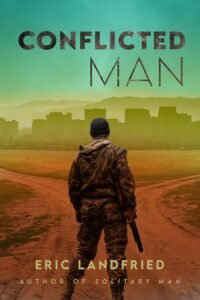
EDITOR’S NOTE
Eric Landfried delivers a thought-provoking and spiritually rich sequel to Solitary Man. In Conflicted Man, he masterfully explores Doyle’s internal and external battles as he navigates a dark, post-apocalyptic world while wrestling with newfound faith. With gripping storytelling, compelling characters, and a hopeful yet realistic message, this book is a heartfelt journey of redemption and resilience. A must-read!